Batch Cooking Without Eating the Same Thing Four Nights Running
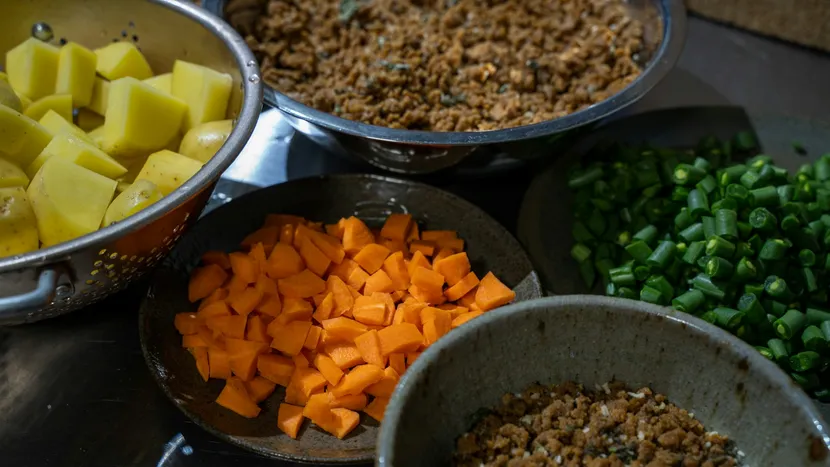
Batch cooking is the simplest form of cooking ahead: make a lot of one thing, eat it across several days. It is the easiest to start and the one people abandon fastest, and the reason is always the same.
Not effort. Appetite. By Wednesday you do not want the chili, and you were the person who made it.
That is a design problem, not a willpower problem, and it is solvable. The fix is to stop batch cooking meals.
Cook components, not dinners
One large pot of finished stew can only ever be that stew. Every portion is identical, and the fourth one is a chore.
Instead, cook three or four things that are not meals yet:
- A grain or starch. A big pot of rice, or couscous, or roasted potatoes, or cooked pasta kept undressed.
- A protein. Shredded chicken thighs, a tray of sausages, spiced mince, roasted chickpeas, a batch of hard-boiled eggs.
- Vegetables, two ways. One tray roasted, one thing raw and crunchy that keeps: cabbage, carrots, peppers.
- Two sauces. This is the part that does the actual work.
Now Monday is rice, chicken and roast vegetables with a yoghurt and lemon sauce. Tuesday is the same chicken in a wrap with the raw cabbage and a chili sauce. Wednesday is fried rice with the leftover vegetables and an egg on top. Thursday is a bowl with whatever remains and the other sauce.
Same session, same ingredients, four dinners that do not taste like each other. The food did not change. The assembly did.
The three levers that make components feel different
Sauce. The biggest lever by a distance, and the cheapest. The same chicken and rice tastes like a different meal under yoghurt, garlic and lemon than under soy, honey and chili. Two sauces made on Sunday take ten minutes between them.
Temperature. Cold roast vegetables in a salad and hot roast vegetables in a bowl are experienced as different food, even though nothing was done to them.
Format. In a bowl, in a wrap, on toast, on top of a salad, folded into an omelette. Format changes the meal more than most people expect, because you eat it differently.
None of these require extra cooking. They are all decisions made at the point of eating, which is exactly where you want the variety to live.
What genuinely freezes and what does not
Worth knowing before you fill a freezer with things you will not want.
Freezes well. Soups and stews, and most improve. Cooked mince and ragu. Curries. Cooked beans and pulses. Bread. Cooked rice, if cooled fast and frozen quickly. Raw portioned meat. Stock. Grated cheese. Most baked goods.
Freezes badly. Anything whose appeal is crispness, which thawing destroys completely. Roast potatoes. Fried food. Pasta already mixed with sauce, which turns to paste. Most fish, unless it was frozen at sea. Dairy-heavy sauces, which split. Salad, obviously. Boiled eggs, which go rubbery.
Freeze in single portions, not one large block. A block has to be thawed in its entirety to use any of it, which means a batch you cannot dip into, which means you do not.
Label everything with what it is and when it went in. Frozen food is anonymous after two weeks, and an unlabeled container is a thing nobody chooses.
Three or four days, not seven
Cooked food holds three to four days in the fridge. That is the actual constraint, and it does not care how well you planned.
Prepping seven days means the last containers are past their best when you reach them. They get skipped, then thrown away, and the conclusion drawn is that batch cooking does not work rather than that day six was always going to be day six.
Cook for three or four days. Freeze anything beyond that immediately rather than leaving it in the fridge hoping.
The session itself
The efficiency comes from overlapping, not from speed.
Start the thing that takes longest and needs no attention, which is usually the oven tray. While it is in, get the pot of grains going. While that simmers, do the chopping for whatever is next and make the sauces, which need no heat. Wash up in the gaps rather than at the end, because the end is when you least want to.
An hour and a half is a realistic session for three or four days of components. Two hours if you are new to it. Anyone telling you it takes twenty-five minutes is describing something smaller than this.
Deciding is still the hard part
Standing in the kitchen on Sunday afternoon working out what to batch cook is the same failure as standing in it on Tuesday at seven, just with more time attached.
The session works when you arrive at it knowing what you are making. That means the deciding happened earlier: at the shop, or when you wrote the list, or the night before. The six o’clock decision is about why that gap matters so much, and it applies to Sunday too.
It also means the shopping has to be right, because a component session with a missing ingredient collapses into improvisation.
Where this sits
Batch cooking is one of four ways people prep, and it is the lowest effort and lowest variety of them. What meal prep actually is covers the other three, including component prep, which is what this page has been quietly arguing for the whole way down.
If your problem is the clock rather than variety, cooking when you have no time makes the case for doubling every meal you cook, which is batch cooking without a dedicated session.
For containers: use what you own for the first few weeks, and read the container comparison only once the habit has proven itself. Buying a matched set first is how cupboards fill with unused plastic.
And if the recipes you would batch cook are scattered across screenshots and saved posts, so that Sunday starts with twenty minutes of hunting, that is what AnyRecipe is for: one place for the recipes, a week built from them, and a shopping list with quantities merged across everything you plan, rounded to the packet sizes shops actually sell. Free to download on iPhone and iPad.
Frequently asked
What is batch cooking?
Cooking a large quantity of something at once and eating it across several meals. It is the lowest effort form of meal prep and the fastest one to get boring, which is the problem worth designing around rather than ignoring.
How do I batch cook without getting bored?
Cook components rather than finished dishes. A pot of grains, a tray of roast vegetables and a batch of cooked protein recombine into four genuinely different meals when you change the sauce, the temperature and the format. One finished stew can only ever be that stew.
How long does batch cooked food last?
Three to four days in the fridge for most cooked dishes, and two to three months in the freezer with the quality still good. Freeze in single portions rather than one large block, because a block has to be thawed entirely to use any of it.
What foods should you not batch cook?
Anything whose appeal is texture. Roast potatoes, anything crisp or fried, pasta already mixed with sauce, and most fish. Salads with dressing on them collapse. Rice is fine but must be cooled fast and reheated properly.